The Challenger’s Compass
Strategies for Success in a Volatile, Uncertain, Complex, and Ambiguous World

Have you ever watched those mesmerizing drone light shows where hundreds of tiny aircraft form perfect constellations against the night sky? One moment they’re stars, the next a spinning globe, then a corporate logo—all while battling invisible wind gusts and maintaining precise formation. Have you ever wondered what happens when one drone’s battery falters or a sudden storm front moves in? That spectacular visual harmony requires constant adaptation behind the scenes.
This is what strategy looks like today—not the neat, predictable plans of yesterday, but a constant dance with Volatility, Uncertainty, Complexity, and Ambiguity (VUCA). Old playbooks no longer work. To thrive, we need a different approach: The Challenger’s Mindset—a way of thinking that embraces doubt, tests bold ideas, and finds clarity in chaos.
The Evolution of Strategic Thinking
Strategy has evolved. Once, it was like steering a ship through a storm with just a compass and the stars—grit and guesswork got you through, relying on established routes and predictable currents. The military planners who originally developed the VUCA framework at the U.S. Army War College in the late 1980s recognized this change first. They saw how the post-Cold War world no longer followed predictable patterns, requiring entirely new approaches to leadership and planning.
But today’s VUCA world is far trickier. It’s less about navigating known waters and more like orchestrating a drone light show—hundreds of individual units flying in precise formation while contending with gusty winds (volatility), relying on sensors with imperfect data to navigate (uncertainty), coordinating complex 3D movements of the entire swarm (complexity), and trusting AI systems to make split-second decisions when conditions change (ambiguity). In this chaos, strategy isn’t just about survival—it’s about mastering new tools and uncertainties with a challenger’s edge.
The Challenger’s Mindset Revisited
As we explored in our previous article, the Challenger’s Mindset—inspired by chess masters and AI breakthroughs like AlphaGo—is about seeking evidence that might prove you wrong to make your decisions stronger.
This same mindset powered AlphaGo’s revolutionary “move 37” in Go, a play so unconventional that it revealed new possibilities, changing the game for decades as its thinking is incorporated into strategies going forward. This mindset isn’t just for games—it’s your compass for mastering the unpredictable waves of a VUCA world.
VUCA, originally a military framework developed at the U.S. Army War College in the late 1980s and explicitly applied to the post-Cold War world of the early 1990s, maps the chaos we all face today. In 2014, Harvard Business Review brought this framework to mainstream business attention with their influential article “What VUCA Really Means for You.” By pairing it with the Challenger’s Mindset, you can turn turmoil into opportunity. Here’s how to navigate the storm.
The VUCA Storm: Chaos in Everyday Life
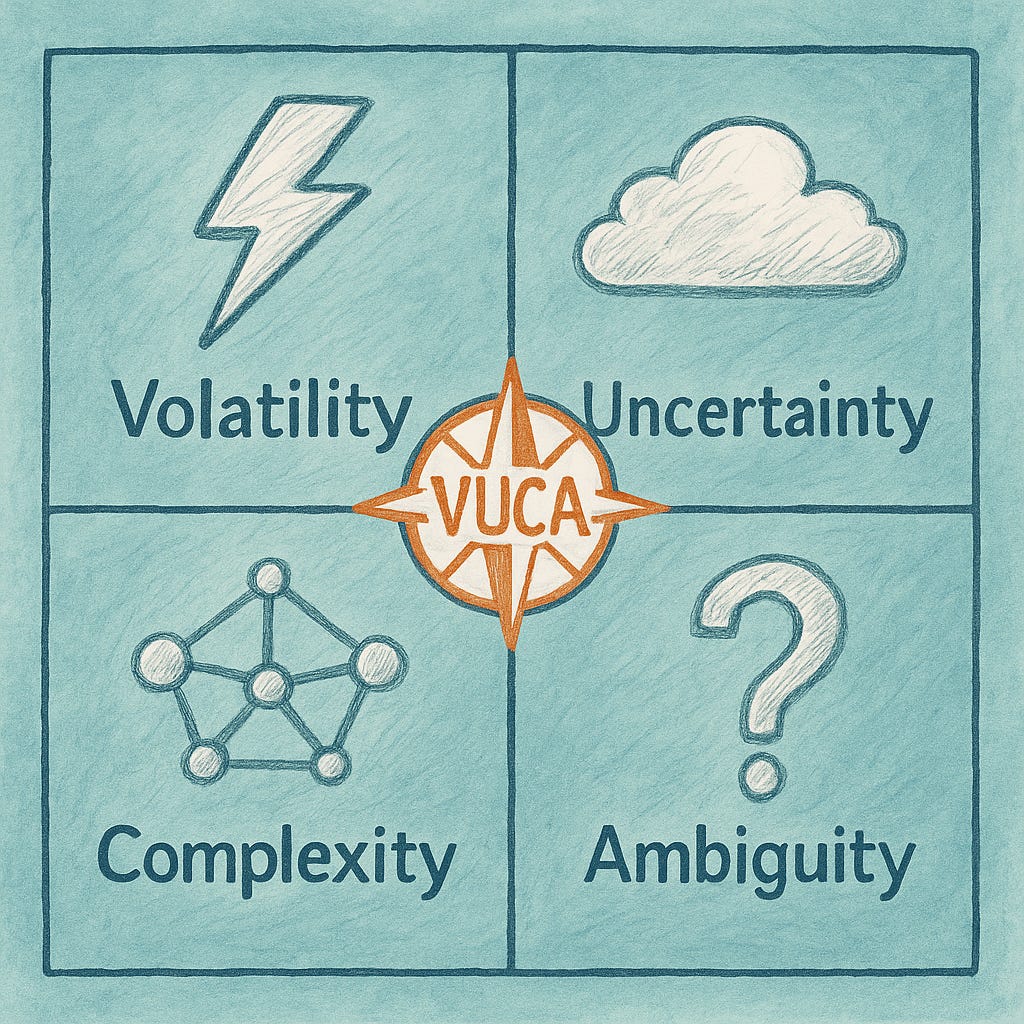
To navigate this reality, we must first understand its components. VUCA describes the forces shaking our world, from global trends to personal challenges. Here’s what that storm looks like in action, and why the Challenger’s Mindset is your best defense:
Volatility: Change strikes fast. A viral social media post can skyrocket a small business or tank a brand overnight. New tech, like generative AI, reshapes industries in months—not the 40 years tractors took to transform farming or even the 15 years personal computers needed to reach mainstream adoption. Personal plans—say, a career switch—can be upended by sudden market shifts.
Uncertainty: The future is murky. Will a new policy change your industry’s rules? How will remote work evolve? When planning a move or a project, unexpected variables—like health or finances—cloud your vision.
Complexity: Everything’s connected. Launching a product involves supply chains, marketing, tech, and regulations, each with countless variables. The 2020 pandemic demonstrated this complexity in stark relief, with public health organizations explicitly using VUCA frameworks to coordinate responses across medical, economic, and social dimensions. Even family decisions, like choosing a school, tangle finances, logistics, and emotions in ways that defy simple answers.
Ambiguity: Clarity is rare. Is that new trend a game-changer or a fad? Does a colleague’s feedback signal conflict or support? Mixed signals and incomplete data make the “right” path feel like a guess.
Relying on past experience or gut alone won’t cut it. A blogger banking on outdated SEO tactics gets buried by algorithm changes. A parent assuming their teen’s silence means all’s well might miss deeper issues. To thrive, you need a mindset that doesn’t just react but anticipates and adapts.
Turning Chaos into Opportunity
The Challenger’s Mindset is your anchor in the VUCA storm. It’s about questioning your plans to make them bulletproof, seeking contradictory evidence to sharpen your thinking, and daring to try bold, unconventional ideas. Here’s how it transforms each VUCA challenge:
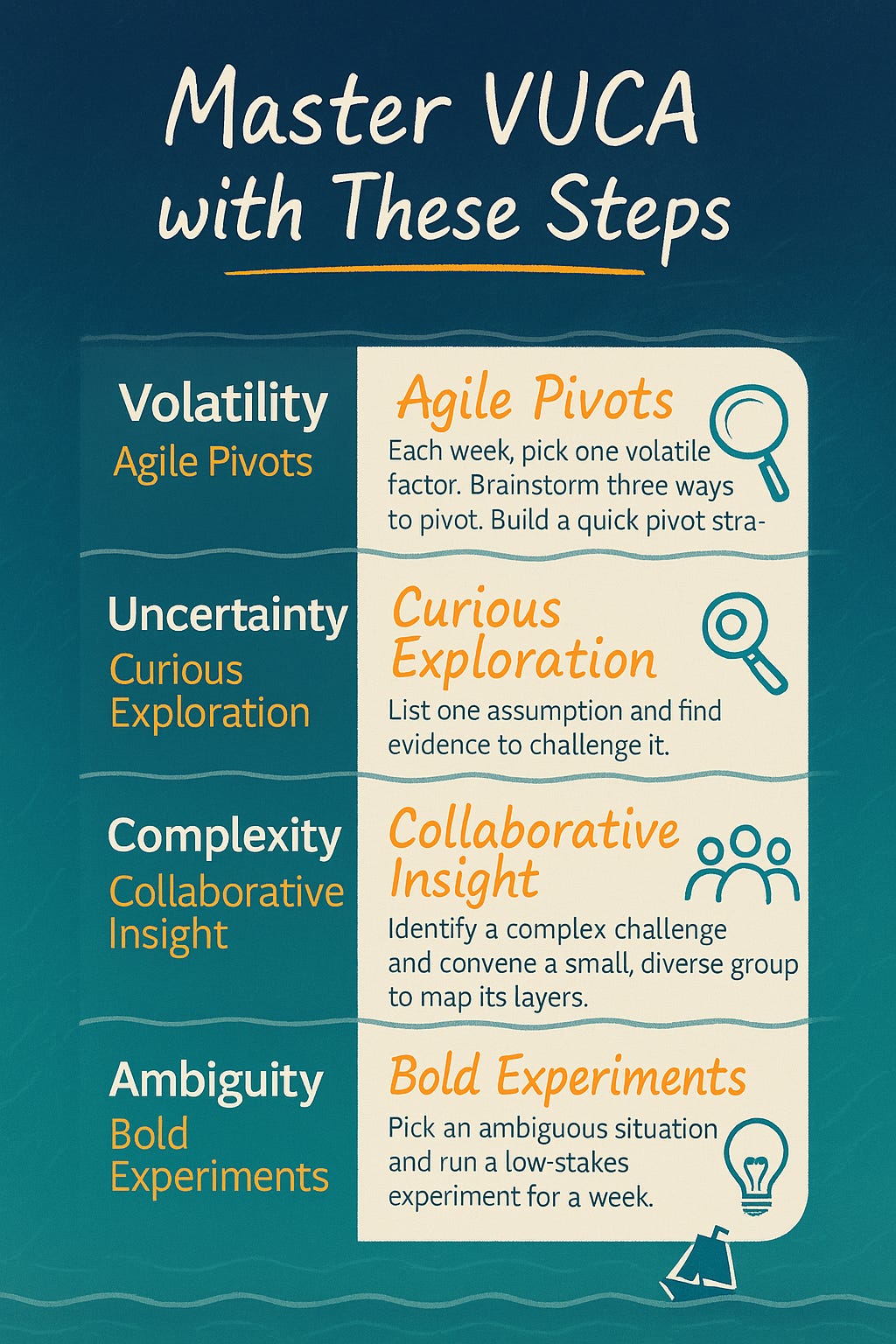
Volatility → Agile Pivots When change hits fast, don’t double down on old plans. Challenge your assumptions about what’s driving the shift. A small business owner facing a supply chain snag in 2024 didn’t just wait it out—they questioned their single-supplier model and diversified, thriving while competitors stalled.
Your Challenge: Each week, pick one volatile factor (e.g., a market trend or personal goal) and brainstorm three ways it could disrupt your plans. Build a quick pivot strategy.
Uncertainty → Curious Exploration Can’t predict what’s next? Embrace the fog by seeking disconfirming data. When a musician launched an album during 2023’s streaming wars, they didn’t assume Spotify was king—they tested platforms like Bandcamp and TikTok, uncovering niche audiences others missed.
Your Challenge: For your next big decision, list one assumption (e.g., “This job offer is stable”) and find evidence that challenges it. Use that to hedge your bets.
Complexity → Collaborative Insight Tangled problems need diverse perspectives. Challenge solo thinking by tapping others’ expertise. A community organizer tackling urban flooding didn’t just consult engineers—they brought in residents, artists, and policymakers, crafting a holistic plan that won funding.
Your Challenge: Identify a complex challenge (e.g., a work project or home renovation) and convene a small, diverse group to map its layers. Synthesize their insights into a clearer plan.
Ambiguity → Bold Experiments Mixed signals? Test small, daring ideas. When a writer faced ambiguous feedback on their novel draft, they didn’t guess at fixes—they shared two versions with beta readers, using data to refine their story. Like AlphaGo’s “move 37,” the best solutions often defy the obvious.
Your Challenge: Pick an ambiguous situation (e.g., a career choice or creative project) and run a low-stakes experiment, like testing a new approach for a week, to clarify the path
.
VUCA, AI, and Our Accelerating World
The connection between VUCA challenges and our previous discussions about AI adoption and human potential is striking. Just as we saw ChatGPT reach 100 million users in merely two months—compared to telephones taking 75 years to reach 50 million—the pace of VUCA challenges has similarly accelerated.
AI itself is both a response to VUCA conditions and a creator of them. The same technology that helps us manage complexity also introduces new ambiguities; tools that help us predict volatile markets can themselves create market volatility. The human-AI partnership we explored in “Unlocking Human Potential” becomes even more crucial when viewed through the VUCA lens, as it combines machine processing power with human judgment to navigate uncertainty.
In this accelerating landscape, organizations and individuals who master both AI capabilities and the Challenger’s Mindset gain compound advantages. As we discussed in “Rethinking the Organization in the Age of AI,” early adopters don’t just implement faster—they learn faster, adapt faster, and build capabilities that become increasingly difficult to replicate.
Why This Matters Now
In a VUCA world, hesitation breeds missed opportunities. The blogger who questions their strategy stays ahead of algorithms. The leader who tests their team’s assumptions builds resilience. The individual who challenges their life choices finds clarity. Pairing the Challenger’s Mindset with VUCA isn’t just a strategy—it’s a superpower for anyone aiming to thrive in chaos, whether in business, creativity, or personal growth.
Your Next Move
Start today. Pick one VUCA challenge—a volatile trend, an uncertain goal, a complex project, or an ambiguous signal. Apply the Challenger’s Mindset: question your assumptions, seek contradictory evidence, and test a bold idea. Share what you learn with a friend or colleague to spark their thinking, too.
When Harvard Business Review published their landmark 2014 article “What VUCA Really Means for You,” they emphasized that success in this environment requires more than just awareness—it demands new approaches to thinking and decision-making. This is where the Challenger’s Mindset becomes invaluable.
In future posts, we’ll dive into specific tools—like crafting resilient plans or making bold decisions under pressure—to help you master chaos in work and life. We’ll also explore how the growing human-AI partnership specifically helps address each element of VUCA, building on the foundation we’ve established in this series. For now, ask yourself: What’s one assumption I’m holding onto that needs a challenge?
The storm’s here, but you don’t have to be tossed about by it. By embracing the Challenger’s Mindset, you gain the clarity and agility needed to not just survive, but thrive, navigating the unpredictable waves of our VUCA world. Are you ready to captain it like a challenger?
What VUCA challenge are you facing, and how might you challenge your assumptions to tackle it?
This article is part of a series examining innovation and strategic thinking in the age of AI. Other articles in the series include “The Challenger’s Mindset: Lessons from Chess Masters, Go Champions, and AI”
“The individual who challenges their life choices finds clarity.” Sometimes, but always, in my experience.
Thanks for sharing…much to mull over.